
We tested the wrap. Here's what 400 diners told us.

It's a Friday lunch rush. A diner at a local burger spot picks up their order, pauses for half a second, and pulls out their phone. The food looks good – but it's the branded paper underneath it, the custom logo wrapping the whole thing, that makes the shot feel worth posting. That photo goes up. Their followers see it. A few of them decide where to eat next week.
Most restaurant operators never think about that moment. The paper is ordered by the case, used by the thousands, and replaced without a second thought. It's a cost line, not a marketing decision.
That assumption is what we wanted to test.
We Commissioned Independent Research to Find Out How Packaging Actually Performs
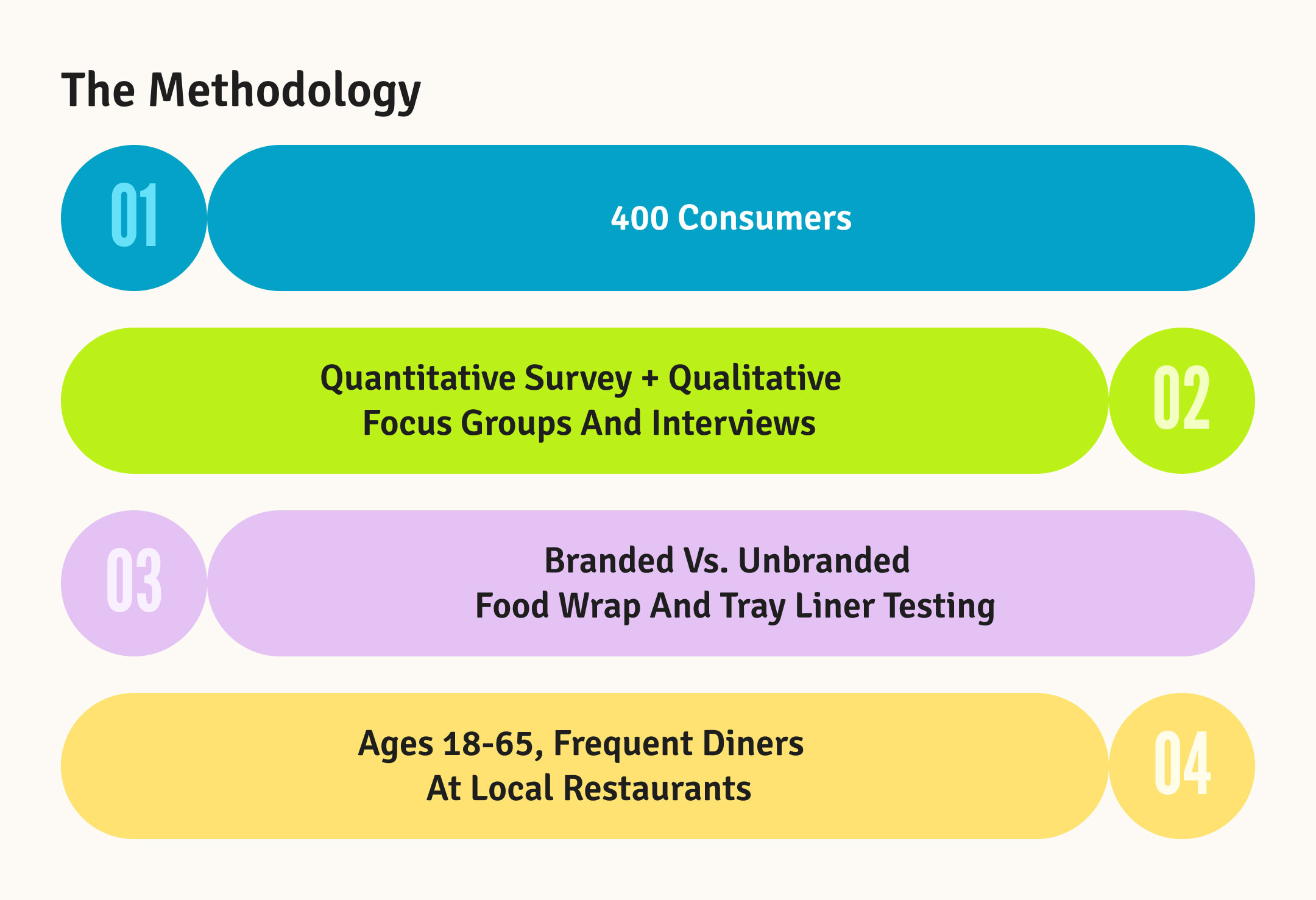
We worked with Michigan State University to find out: how do consumers actually respond to branded food wrappers and tray liners compared to plain packaging?
We recruited 400 US consumers, ages 18-65 – all regular diners at local, independently owned restaurants. They took a quantitative survey and a portion joined focus groups and one-on-one interviews. Each participant was shown the same food in real scenarios: plain vs. branded. We asked what they noticed, what they preferred, and how the packaging changed how they felt about the food and the restaurant.
Here's what they told us.
What the Research Found
- 87% of diners notice food packaging at least sometimes
- 82% prefer branded food packaging – only 11% prefer plain
- 86% say food presentation influences how they perceive quality
- 78% are more likely to choose a restaurant with branded tray liners
- 60% are more likely to photograph a meal in visually appealing packaging
- 57% expect to pay more for food served in well-designed packaging
Diners Are Paying Attention – Whether You Are or Not
Before a single bite, customers are forming an impression.
87% of diners notice food packaging at least sometimes. 56% notice it frequently. That's not a niche audience of packaging obsessives – that's essentially everyone who walks through your door, sits at your counter, or picks up a takeout order.
The wrap, the liner, the logo – or the absence of one – all communicate something about the quality of the food and the care behind the restaurant. Most operators don't think of it that way, but their customers do.
82% Prefer Branded. Only 11% Prefer Plain.
When we put branded and plain packaging in front of consumers side by side, the results weren't close.
- 82% prefer branded food packaging over unbranded
- Only 11% preferred the plain option
- 86% say food presentation influences how they perceive quality
- 89% say attractive packaging raises their expectations for the meal – before they've tasted it
That last one matters. Expectations are formed before the first bite. The packaging is already making a case for the food.
Plain paper isn't neutral. It's working against you.

Branded Packaging Drives Restaurant Choice
The preference for branded packaging doesn't stop at aesthetics. It shapes where people choose to eat.
- 78% are more likely to choose a restaurant with branded tray liners
- 73% of tray liner users say branded packaging adds noticeable to significant value to their dining experience
- 88% hold a positive attitude toward branded food packaging overall
That first number is significant. 78% is a competitive signal – the kind that typically requires advertising spend to move. Here, the paper does the work.
Your Next Customer Might Come From the Last Meal You Wrapped
Social media has changed how people discover restaurants. 77% of consumers turn to social media for meal decisions. 93% encounter food content in their feed.
Food content is already everywhere. The question is whether your food is in it – and whether it looks like it belongs to a brand worth remembering.
Our research found that 60% of consumers are more likely to photograph a meal served in visually appealing packaging.
That's unprompted. Unpaid. Reaching an audience you didn't have to buy. Every service is a potential content moment – and branded paper is the thing that tips a meal from "food I ate" to "food I shared."

The Paper Can Help You Charge More
Here's the part that tends to surprise operators.
- 57% expect to pay more for food served in well-designed packaging
- 74% are willing to pay more for a better-presented meal
- ~70% still preferred the branded option even when it cost nearly 20% more
- Preference shifted by +16 percentage points when restaurants moved from plain to branded at a modest price increase
The paper didn't replace the food. It changed what the food felt worth.
Most operators start the conversation at cost. A better question is return: what does branded paper do to quality perception, restaurant choice, social sharing, and willingness to pay? When you add those up, it frequently pays for itself.

What This Looks Like in Practice
The 500-sheet minimum means this isn't a decision reserved for chains. An independent burger joint, a bakery, a food truck, a pub – any food business that cares about how its food is presented can get custom-printed grease-resistant paper starting from 500 sheets, in as few as 7-10 business days after art approval.
Free artwork is included. Upload your logo on the website – vector files preferred, but JPGs and PNGs are okay too. The team handles the rest.
Operators have always sensed it. Now there's independent data behind it: presentation is part of the product.

Get the latest scoop
Here's some food for thought for all things food service paper:


